

 English
  Français
  عربى
عربى How Does the QMJ Series Chocolate Ball Mill Achieve Sub-20-Micron Cocoa Fineness?
Content
- 1 Why Particle Size Is the Single Biggest Lever in Chocolate Texture
- 2 How the QMJ series chocolate ball mill Reduces Cocoa Solids to Fine Particle Size
- 3 What the Fineness Curve Looks Like Over a Grinding Cycle
- 4 Fineness Achieved at Each Stage of Mechanical Reduction
- 5 Batch Grinding Compared With Continuous Refining Systems
- 6 Where the QMJ-1 Batch Type Chocolate Ball Mill Fits in a Production Line
- 7 Operational Practices That Keep Fineness Consistent Batch After Batch
- 8 Maintenance and Longevity Considerations for Ball Mill Systems
- 9 Frequently Asked Questions
- 9.0.1 Q1: What particle size should chocolate reach for a smooth mouthfeel?
- 9.0.2 Q2: How long does a typical grinding cycle take?
- 9.0.3 Q3: Can a chocolate ball mill process products other than chocolate?
- 9.0.4 Q4: Why does grinding slow down significantly in the later stage of a cycle?
- 9.0.5 Q5: What is the biggest cause of inconsistent fineness between batches?
Why Particle Size Is the Single Biggest Lever in Chocolate Texture
Every experienced chocolate maker eventually learns the same lesson: recipe adjustments can only do so much if the particle structure of the mass is wrong. The human tongue detects solid particles once they exceed roughly 25 to 30 microns, which is why the grinding stage, not the ingredient list, ultimately decides whether a chocolate feels silky or gritty. Cocoa solids, sugar crystals, and milk powder all start out far coarser than this threshold, sometimes in the 100 to 200 micron range straight out of pre-mixing, and it takes a controlled mechanical reduction process to bring the entire particle population down below the perception line.
This is where a chocolate grinder machine built around steel media does work that simple mixing or conching alone cannot achieve. Conching develops flavor and manages moisture and viscosity, but it is a comparatively poor tool for breaking down hard sugar and cocoa fragments. Fine grinding has to happen first, and it has to happen consistently across every batch, or the downstream flavor development stage will be trying to polish particles that are still too large to ever feel smooth.
Undersized particles carry their own risk too. Grinding cocoa butter suspensions far below the target range increases the surface area that needs to be coated in fat, which raises viscosity and can make later processing steps such as tempering and molding more difficult. The objective is not simply smaller, it is a narrow and predictable particle size distribution that matches the intended product category, whether that is a couverture for enrobing, a compound coating, or a filling paste.
Why a Single Average Number Does Not Tell the Whole Story
Two batches can report the same average fineness reading and still feel noticeably different on the tongue. What matters as much as the average is the spread of the distribution: a batch where nearly all particles cluster tightly around 20 microns will feel smoother than one with the same average but a long tail of oversized fragments still present. This is one of the reasons experienced quality teams look at more than a single grindometer reading before releasing a batch, since a narrow distribution is a stronger predictor of mouthfeel than the mean value alone.
Achieving that narrow distribution consistently is largely a function of dwell time inside the grinding chamber and how evenly the mass is exposed to the media bed. A machine that channels mass unevenly, letting some of it bypass the highest-shear zones, will always produce a wider spread regardless of how long the overall cycle runs, which is why chamber design and flow uniformity matter as much as raw grinding power.
How the QMJ series chocolate ball mill Reduces Cocoa Solids to Fine Particle Size
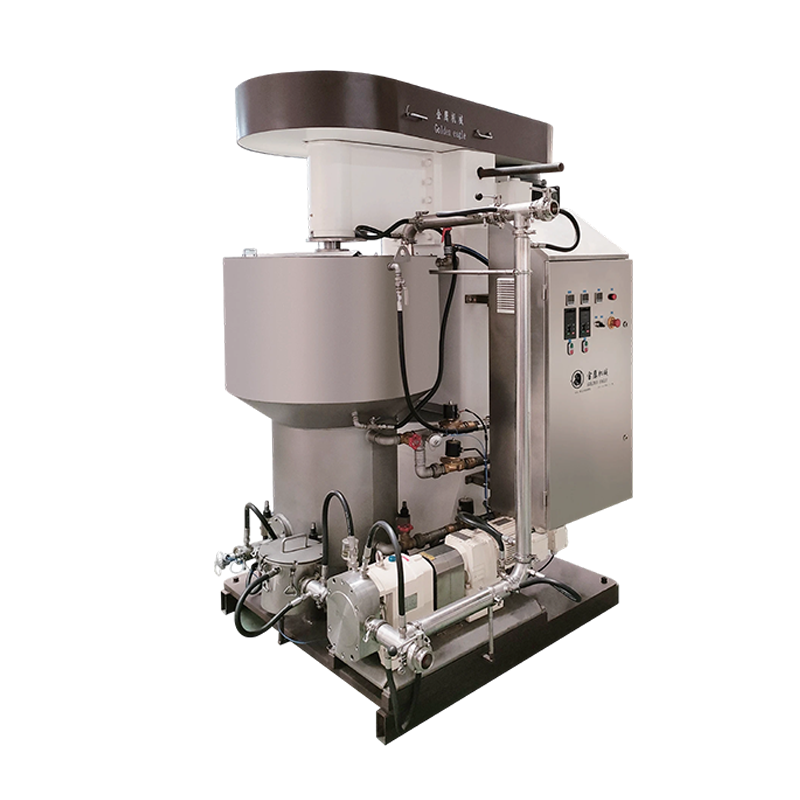
A ball mill for chocolate works on a straightforward mechanical principle: the pre-mixed mass is pumped through a vertical grinding cylinder packed with hardened steel or ceramic beads, driven by a rotating shaft. As the beads collide with the suspended particles under controlled shear, the coarse fragments of sugar and cocoa solids are progressively fractured. The mass is then recirculated from a jacketed holding tank back through the grinding chamber, pass after pass, until the entire batch reaches the target fineness rather than just the portion that happened to flow through first.
Temperature control matters as much as the mechanical action itself. Friction inside the grinding chamber generates heat, and if that heat is not managed through a water jacket around both the tank and the cylinder, the fat phase can overheat, alter its crystal behavior, or accelerate unwanted flavor changes. A well-engineered cacao grinder keeps the mass within a narrow temperature band throughout the entire cycle so the only variable changing over time is particle size, not viscosity drift caused by temperature swings.
Process Flow: From Pre-Mix to Finished Fineness
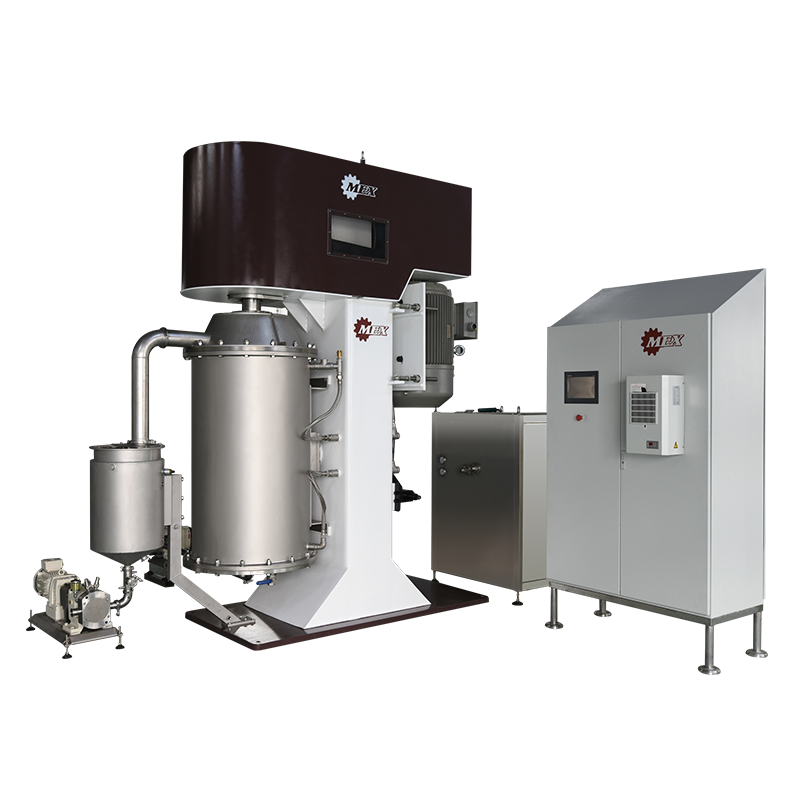
Because the beads themselves gradually wear, the mill design also has to account for media separation, keeping the grinding elements inside the chamber while allowing the liquefied mass to pass freely through a fine screen at the outlet. This separation stage is often overlooked in casual descriptions of ball milling, yet it is one of the more failure-prone components in daily operation, and it directly affects both product purity and how often the machine needs to be opened for maintenance.
Choosing Media Size for the Batch on Hand
Bead diameter is not a fixed setting; it is a variable that experienced operators adjust to the recipe. Larger beads deliver more impact force and are better suited to the earlier stage of a cycle when particles are still relatively coarse, while smaller beads pack more tightly and create more contact points per pass, which favors the final polishing stage where the remaining particles are already small and need frequent, gentler impacts rather than brute force. Running an entire batch on a single bead size is a common shortcut that tends to leave either the early stage underpowered or the final stage less efficient than it could be.
Batch viscosity also shifts as fineness improves and fat coats a larger total particle surface area, so the same rotational speed that moved mass efficiently at the start of a cycle may need to be reduced later on to avoid excessive heat build-up in a thicker suspension. This is a subtle adjustment that separates a batch finishing on schedule from one that stalls a few tenths of a micron short of target.
What the Fineness Curve Looks Like Over a Grinding Cycle
Fineness reduction is not linear. The first hour of grinding typically removes the largest and most fragile particles quickly, producing a steep drop on any fineness-versus-time chart. As the remaining particles get smaller and harder to fracture, the rate of improvement slows, which is why operators watching only the early curve sometimes assume the machine is more powerful, or the batch will finish faster, than it actually will.
Fineness Reduction Over a Typical Grinding Cycle
In practical terms, this curve is why most operators check fineness with a hand-held micrometer or grindometer at regular intervals rather than relying on a fixed timer alone. Ambient temperature, the freshness of the grinding media, and the ratio of cocoa butter to solids in the pre-mix all shift where the curve flattens out. A batch with a higher fat content generally grinds faster because the particles move through the media bed with less resistance, while a leaner recipe with more dry solids takes longer to reach the same endpoint.
Running the mill well past the point of diminishing returns wastes energy and adds unnecessary wear to both the beads and the shaft seals without meaningfully improving mouthfeel. The most efficient operators treat the curve as a stopping signal, not a target to overshoot.
Fineness Achieved at Each Stage of Mechanical Reduction
Breaking the overall process into discrete stages makes it easier to diagnose where a batch is underperforming. A coarse pre-crush handles the largest sugar crystals, a pre-grind pass brings the mass into a workable suspension, and the ball mill itself carries out both a primary reduction and a final polishing pass. Each stage has its own realistic output range, shown below.
Typical Output Fineness by Processing Stage
| Processing Stage | Output Fineness | Primary Purpose |
|---|---|---|
| Coarse crush | Approx 150um | Break down raw sugar and nib fragments |
| Pre-grind pass | Approx 85um | Create a pumpable suspension |
| Ball mill primary | Approx 35um | Bulk particle size reduction |
| Ball mill final polish | Approx 20um | Reach sensory smoothness target |
Skipping the pre-grind stage and feeding an overly coarse mass directly into the mill is one of the more common causes of uneven results, since oversized fragments can jam the media separation screen or force the mill to run far longer than the rated cycle time suggests.
It is also worth noting that these ranges shift with recipe composition. A high-fat couverture formulation tends to move through each stage slightly faster than a leaner, higher-solids compound coating, simply because the additional fat acts as a lubricant between particles and the grinding media. Facilities running a wide product mix often keep a short reference table like this on hand for each major formulation rather than relying on a single generic cycle time for every batch that comes through the line.
Batch Grinding Compared With Continuous Refining Systems
Producers weighing a ball mill for chocolate against a continuous multi-cylinder refining line are really deciding between two different production philosophies. Batch systems, such as a QMJ Batch Type Ball Mill, process a fixed quantity of mass from start to finish in one tank before moving on, which makes recipe changeovers straightforward and keeps capital costs manageable for small and mid-sized operations. Continuous systems push mass through a series of chambers in an uninterrupted stream, favoring facilities that run the same formulation around the clock at higher volumes.
Batch Grinding vs Continuous Refining: Performance Profile
The radar profile above illustrates a common trade-off pattern rather than a universal rule. Batch grinding tends to score higher on recipe changeover speed and capital efficiency because a single tank can be cleaned and reloaded with a different formulation in a matter of hours, while a continuous line often needs to run a full flush cycle to avoid cross-contamination between recipes. Continuous systems generally pull ahead on sustained throughput once a facility commits to a narrow product range at large volume, since the mass never stops moving through the chambers.
Fineness control and homogeneity can be comparable across both formats when the equipment is properly sized and maintained, which is why the decision usually comes down to production mix rather than raw grinding capability alone.
Where the QMJ-1 Batch Type Chocolate Ball Mill Fits in a Production Line
Smaller batch machines occupy a specific niche in the broader landscape of chocolate and confectionery manufacturing. They are common in facilities that need flexibility more than raw throughput, including craft and artisan producers running frequent recipe changes, pilot and product development lines validating new formulations before a full-scale production commitment, and mid-sized manufacturers supplementing a larger continuous line with capacity for specialty runs.
This class of machine also functions well as a cocoa beans grinding machine supplement earlier in a process, refining cocoa nibs or liquor before it is blended with sugar and milk components, since the same recirculation grinding principle applies whether the input is a finished cocoa mass or a more concentrated liquor stream.
Beyond chocolate itself, the same mechanical approach is frequently applied to nut butters, seed pastes, and certain spread formulations that require a comparable reduction from coarse particles to a smooth suspension, which is part of why batch ball mills tend to be a versatile fixture in mixed-product confectionery facilities rather than single-purpose equipment.
Scaling From Pilot Batches to Fuller Production Runs
Many facilities begin with a compact batch unit specifically because it lets a development team validate a new formulation, packaging concept, or seasonal product on a small enough scale that a misstep does not waste a large volume of ingredients. Once a recipe is finalized and demand grows, the same batch grinding principles typically translate directly to a larger tank size, since the underlying physics of media impact and recirculation do not change with volume, only the throughput per cycle does. This makes a small batch mill a practical starting point rather than a piece of equipment that gets retired once volume increases, since it continues to serve specialty and limited-run production even after a larger line comes online.
Operational Practices That Keep Fineness Consistent Batch After Batch
Consistency is where many operations lose more value than they realize. A machine capable of excellent fineness on a well-run batch can still produce uneven results if a few operational habits are neglected.
- Pre-screen incoming sugar and dry ingredients to remove oversized clumps before they ever reach the mixing tank.
- Maintain jacket water temperature within the manufacturer's specified range rather than letting it drift with ambient conditions.
- Sample fineness at fixed intervals using the same measurement method each time to keep readings comparable across batches.
- Inspect the media separation screen regularly for wear, since a damaged screen can let beads escape into the product stream.
- Log cycle time against fineness results over time to build a reference curve specific to each recipe.
Operators who track fineness data across dozens of batches often find that the largest source of variation is not the mill itself but inconsistent pre-mix ratios entering the grinding stage. Tightening upstream mixing control frequently improves repeatability more than any adjustment made to the mill settings.
Recipe-specific documentation matters because a formulation with a higher proportion of cocoa butter behaves very differently under shear than a leaner compound coating, and treating every batch with the same fixed cycle time regardless of composition is one of the more avoidable sources of wasted energy and inconsistent product.
Maintenance and Longevity Considerations for Ball Mill Systems
Grinding equipment operating with abrasive media under continuous mechanical load has predictable wear points, and a basic maintenance schedule extends both service life and product consistency.
| Component | Typical Check Interval | Failure Signal to Watch For |
|---|---|---|
| Grinding media (beads) | Every 500-800 operating hours | Slower fineness progression than historical average |
| Shaft seals | Monthly visual inspection | Visible leakage or product buildup at seal housing |
| Separation screen | Weekly cleaning cycle | Reduced flow rate or bead carryover in discharge |
| Jacket cooling system | Quarterly descaling | Rising mass temperature under normal load |
| Drive motor and bearings | Per manufacturer schedule | Unusual vibration or noise during startup |
Most unplanned downtime traces back to only two or three of these components, which is why building a simple checklist and assigning it to a specific shift is often more effective than relying on equipment simply running until something fails. A machine that receives routine bead top-ups and seal checks can typically be expected to hold its rated fineness performance for many years of regular production.
Frequently Asked Questions
Q1: What particle size should chocolate reach for a smooth mouthfeel?
Most producers target a final fineness between 18 and 25 microns, since the human palate generally cannot detect particles below this range, while formulations for compound coatings or fillings sometimes allow a slightly coarser endpoint depending on the intended texture.
Q2: How long does a typical grinding cycle take?
Cycle length varies with batch composition and starting fineness, but two to four hours is common for bringing a pre-mixed cocoa and sugar suspension down to target fineness in a batch-type mill.
Q3: Can a chocolate ball mill process products other than chocolate?
Yes, the same recirculation grinding principle is widely used for nut butters, seed pastes, cocoa liquor refining, and certain spread or filling formulations that require reduction from a coarse suspension to a smooth paste.
Q4: Why does grinding slow down significantly in the later stage of a cycle?
As particles shrink, they become harder to fracture and offer less resistance for the grinding media to act on, which naturally flattens the fineness curve even though the mechanical action inside the chamber has not changed.
Q5: What is the biggest cause of inconsistent fineness between batches?
Variation in the pre-mix ratio entering the mill, along with drifting jacket temperature, are the two most common causes, both of which can usually be corrected through tighter upstream process control rather than changes to the mill itself.