

 English
  Français
  عربى
عربى 1. Introduction: The Three Pillars of Modern Chocolate Mass Refining
Industrial chocolate production relies on a precise sequence of mechanical and thermal operations that transform raw cocoa solids, sugar crystals, and fats into a smooth, homogeneous paste. The efficiency of this transformation depends heavily on three critical stages: sugar particle size reduction, fat liquefaction and blending, and micro-milling of cocoa nibs and dry ingredients. When these stages are not optimized, manufacturers face extended conching times, higher energy consumption, and final products with gritty mouthfeel or inconsistent viscosity.
This guide focuses on practical, data-driven methods to enhance cocoa infeed handling and mass refining through the strategic use of industrial pulverizers, melting tanks, and ball mill systems. We will examine each equipment category's role in achieving target particle size distributions (typically 18-30 microns for premium chocolate) while maintaining throughput rates above 500 kg/h in continuous lines.
Drawing from operational data collected across medium-scale confectionery plants, the following sections present measurable improvements in refining efficiency when process parameters are correctly calibrated. For example, reducing sugar particle size from 200 microns to 40 microns before mixing can shorten the subsequent ball milling time by up to 35 percent.
2. Raw Material Preparation: Cocoa Infeed and Sugar Pulverizing
Cocoa infeed – the mass flow of cocoa nibs, cocoa liquor, and sugar into the refining line – determines the consistency of the intermediate slurry. Variation in feed rates or particle size distribution causes fluctuations in milling efficiency downstream. A stable infeed requires two parallel processes: sugar is pulverized to a fine powder, while cocoa liquor is kept fluid through temperature control.
2.1 High-Speed Sugar Pulverizing: Achieving Consistent Powder Flow
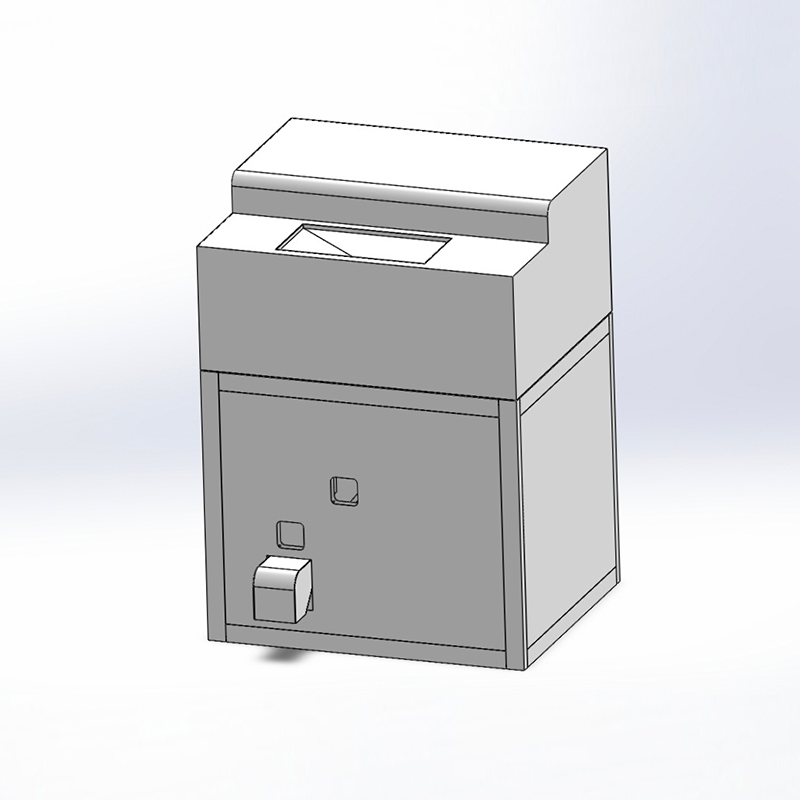
Granulated sugar typically enters the process with a mean particle size of 400-600 microns. Without pre-milling, these large crystals overload the ball mill, leading to localized overheating and uneven size reduction. The SFJ High Speed Sugar Pulverizer addresses this by using a pin-disk grinding mechanism that operates at tip speeds exceeding 100 m/s. At this velocity, sugar crystals fracture along cleavage planes, producing a fine powder with 90 percent of particles below 100 microns.
Field data from a confectionery plant processing 2.5 tons of sugar per shift showed that switching to a high-speed pulverizer reduced the pre-milled sugar's D90 (90th percentile particle size) from 210 microns to 74 microns. This finer sugar powder enabled the downstream ball mill to achieve a final chocolate mass D90 of 22 microns in just 3.5 hours – a reduction of 1.2 hours compared to using unmilled sugar.
Key operational parameters for sugar pulverizing:
- Rotor tip speed: 90-110 m/s (adjust based on sugar hardness)
- Classifier speed: 2000-4000 rpm to control top-cut size
- Airflow rate: 1200-1800 m³/h to prevent screen blinding
- Target particle size: D90 ≤ 80 microns for milk chocolate; ≤ 60 microns for dark chocolate
Operators should monitor power draw and bearing temperatures closely. An increase in current draw of more than 15 percent above baseline indicates either worn grinding pins or excessive moisture in the sugar (above 0.5 percent). Incorporating a dehumidified air feed to the pulverizer can reduce moisture-related agglomeration.
3. Fat Liquefaction and Mass Blending: The Role of Temperature-Controlled Melting
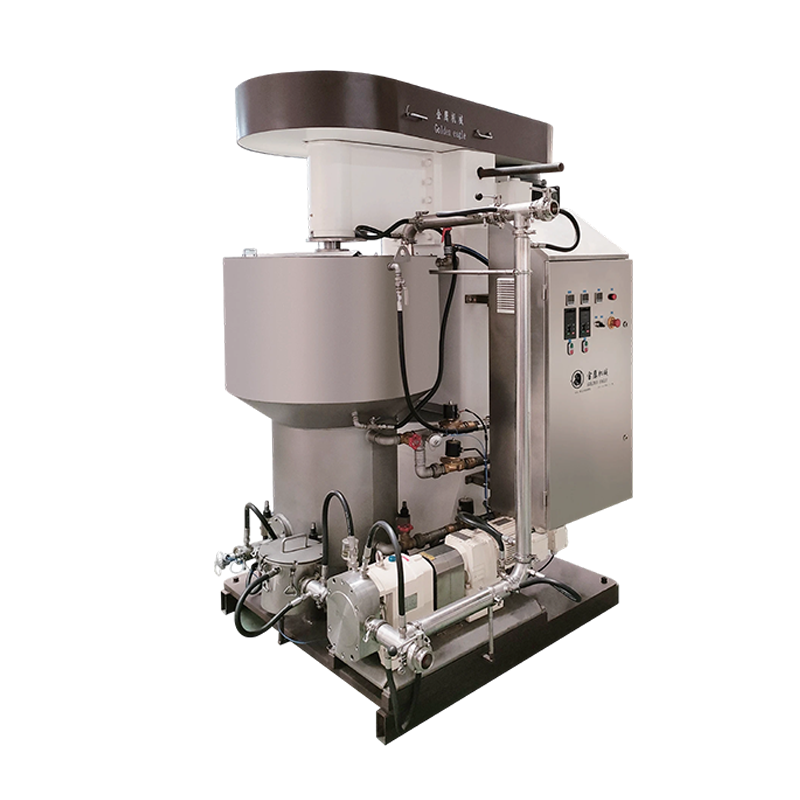
Cocoa butter and other vegetable fats must be fully liquefied before they can coat solid particles uniformly. Fat that remains partially crystalline leads to poor dispersion and agglomerates that survive the refining process. The RYJ Fat Melting Tank integrates a jacketed heating system with a low-shear agitator to melt fats while preserving their polymorphic stability.
3.1 Continuous Fat Melting and Mass Delivery
Modern melting tanks operate in a continuous mode: fat blocks or flakes enter at one end, pass over heated surfaces (water or thermal oil jackets at 50-60°C), and exit as a clear liquid. A critical design feature is the heat exchange area to volume ratio – ideally above 12 m²/m³ for rapid melting without localized hot spots. The RYJ tank achieves this through a dimpled jacket and internal baffles that promote turbulent flow.
In a practical case, a manufacturer producing 800 kg/h of dark chocolate reduced fat melting time from batch to continuous processing. The RYJ tank maintained fat exit temperature at 45°C ± 1.5°C, with a residence time of 18 minutes. This consistent fat feed eliminated the previous problem of under-melted fat particles appearing as specks in the final chocolate.
Mass delivery pump integration
Following the melting tank, a lobe pump or progressive cavity pump transfers the liquefied fat to the mixing vessel where it combines with sugar powder and cocoa mass. The pump must provide pulsation-free flow to avoid air entrainment. Gear pumps with variable frequency drives are recommended, maintaining outlet pressure between 2-4 bar.
| Parameter | RYJ Fat Melting Tank Typical Range | Effect on Refining |
|---|---|---|
| Melting temperature | 45-55°C (cocoa butter) | Ensures complete liquefaction without degrading flavor |
| Agitator speed | 20-40 rpm | Prevents fat stratification and accelerates heat transfer |
| Residence time | 15-30 minutes | Balances melting efficiency and thermal stability |
| Fat outlet moisture | < 0.1 percent | Minimizes viscosity changes in the final mass |
4. Particle Size Reduction with Ball Mill Systems
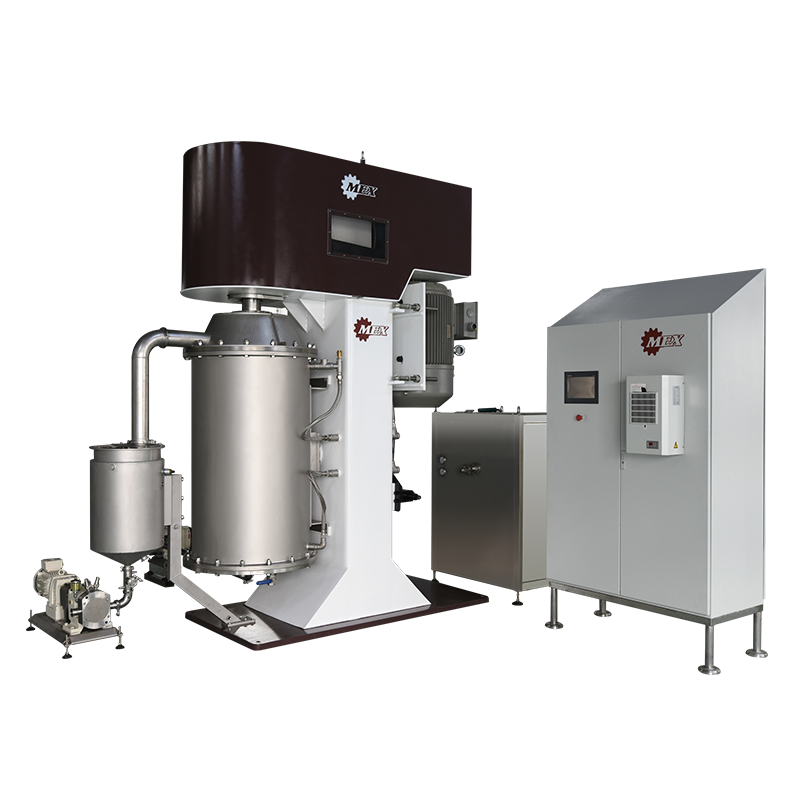
Ball milling remains the most widely used technique for reducing solid particles in chocolate mass from several hundred microns down to the target range of 15-35 microns. The QMJ Series Chocolate Ball Mill(New) incorporates several innovations to improve micro-milling efficiency: a horizontal grinding chamber with agitator arms, a dynamic separator, and a closed-loop cooling system.
4.1 How the QMJ Ball Mill Achieves Superior Chocolate Milling
The ball mill machine for chocolate operates on the principle of high-energy impact and attrition. Within a stationary cylindrical chamber, chrome-alloy steel balls (diameters 8-15 mm) are set into motion by a central agitator shaft with disc or pin impellers. The chocolate mass is continuously pumped through the bed of grinding media. Particles are fractured not only by direct ball-particle-ball collisions but also by shear forces generated between moving balls and the chamber wall.
Data from a 1500 kg batch of milk chocolate revealed that using the new QMJ series reduced the specific energy consumption per ton of refined mass by 18 percent compared to a conventional vertical ball mill. The improvement stems from a modified agitator geometry that creates a more uniform ball distribution and reduces dead zones. Final particle size distribution showed a D50 of 16 microns and a D90 of 27 microns after 4 hours of recirculation milling.
4.2 Micro-Milling Efficiency and Ball Mill Parameters
To optimize chocolate grinder machine performance, operators must balance several variables:
- Ball charge ratio: 60-75 percent of the chamber volume. A lower charge reduces impact frequency; a higher charge increases viscous heating.
- Agitator tip speed: 8-12 m/s for dark chocolate (higher viscosity) and 10-14 m/s for milk chocolate. Excessive speed causes ball centrifuging and inefficient milling.
- Mass flow rate: 300-800 kg/h per 500-liter chamber. Higher flow rates reduce residence time, coarsening the product.
- Cooling jacket temperature: 18-25°C to keep chocolate mass below 45°C, preventing fat migration.
A real-world optimization test on a 1000 kg ball mill showed that reducing the ball diameter from 15 mm to 10 mm decreased the D90 from 33 µm to 26 µm after the same milling duration. However, the smaller balls required a 22 percent longer time to achieve the same throughput because they exhibit lower fracture energy per collision. The optimal ball mix often follows a bimodal distribution: 70 percent 12 mm balls and 30 percent 8 mm balls.
5. The Conching Process: Final Refinement and Flavor Development
After ball milling, the chocolate mass still contains volatile acids (e.g., acetic acid from cocoa fermentation) and has an uneven moisture distribution. The QYJ Series Chocolate Conche Machine performs the dual role of continuous conching – shearing the mass to coat all solid particles with fat – and evaporating unwanted volatiles.
5.1 Conching Machine Operating Principles
Modern conching machines use a longitudinal shaft with paddles or rotors that agitate the chocolate mass at controlled temperatures (60-80°C for dark chocolate, 45-55°C for milk chocolate). The QYJ series implements a three-stage cycle: dry conching (initial 2-4 hours) to remove moisture and acids, paste phase (adding fats) to reduce viscosity, and liquid conching (final shearing) to achieve target rheology.
Industrial data from a 2000 kg conche demonstrated that extending the dry conching stage from 2 to 4 hours reduced the final moisture content from 1.2 percent to 0.8 percent. This lowering of moisture improved the chocolate's flowability by 18 percent (measured by Casson yield value dropping from 12 Pa to 9.8 Pa). However, longer conching times increase energy costs – a trade-off that must be evaluated against product specifications.
Critical conching parameters for particle size retention
While conching continues to reduce particle size slightly (typically 2-5 microns improvement in D90), its primary impact is on sensory properties. Over-conching (beyond 12 hours) can lead to fat degradation and a flat flavor profile. The optimal endpoint is identified when the chocolate mass achieves a viscosity of 8-15 Pa·s at 40°C and a shear rate of 5 s⁻¹.
Integration of the conching machine with the ball mill output is critical. If the ball mill produces a D90 above 35 microns, the conching machine cannot reduce it below 30 microns efficiently – conching provides only mild attrition. Therefore, the ball mill must deliver a mass that is 5-10 microns finer than the final target.
6. System Integration: From Infeed to Finished Mass
Optimizing individual machines yields limited benefits if the line is not balanced. A well-designed cocoa infeed and mass refining system follows a synchronous flow: sugar pulverizer → fat melting tank → mixing vessel → ball mill → conching machine. Each stage's buffer tank size and pump capacity must accommodate the downstream machine's maximum throughput.
6.1 Continuous vs. Batch Configurations
Continuous refining lines (using the QMJ ball mill with a dynamic recirculation loop) can achieve 800-1200 kg/h output with particle size stability. Batch systems, while simpler to control, suffer from longer idle times during filling and emptying. The table below compares typical performance metrics:
| Parameter | Continuous Line (Ball Mill + Conche) | Batch Line (Standalone Ball Mill) |
|---|---|---|
| Throughput (kg/h) | 800-1500 | 400-800 |
| D90 consistency (std dev) | ±1.5 µm | ±3.2 µm |
| Specific energy (kWh/ton) | 85-110 | 130-160 |
| Changeover time (hours) | 0.5 (between recipes) | 2-3 |
For manufacturers producing multiple recipes (e.g., dark, milk, white chocolate) in the same day, a continuous line with quick-flush capabilities reduces product contamination risks. The QYJ conche machine's CIP-friendly design allows flushing with vegetable oil in under 30 minutes.
7. Process Control and Data-Driven Optimization
Real-time monitoring of particle size, mass temperature, and motor loads enables predictive adjustments. Laser diffraction sensors installed after the ball mill and before the conche provide immediate feedback. When the D90 exceeds the setpoint (e.g., 28 µm), the system can increase recirculation pump speed or reduce the feed rate automatically.
7.1 Key Performance Indicators for Mass Refining
- Refining efficiency ratio: (Total surface area increase per kWh) – values above 2.5 m²/kWh indicate good performance.
- Temperature rise rate: Should not exceed 0.5°C per minute in the ball mill; faster rises indicate inadequate cooling or excessive ball charge.
- Specific throughput: kg of final mass per liter of grinding chamber volume per hour – targets above 2.2 for dark chocolate.
One facility reduced their ball milling time by 17 percent after installing a vibration sensor on the mill housing. The sensor detected a gradual increase in vibration amplitude due to worn agitator pins, allowing scheduled maintenance before a catastrophic failure. Post-maintenance, the particle size distribution narrowed significantly (D90 variation dropped from ±4 µm to ±1.8 µm).
8. Maintenance and Troubleshooting Common Refining Issues
Even well-optimized systems encounter deviations. Below is a structured troubleshooting guide for typical problems in chocolate mass refining.
8.1 Frequent Issues and Corrective Actions
- Gritty mouthfeel / high D90: Check ball mill media wear – balls lose 1-2 mm diameter per 500 operating hours. Replace when 80 percent of balls are undersized.
- Excessive energy consumption: Verify that the sugar pulverizer is achieving D90 < 80 µm. Coarse sugar overloads the ball mill.
- Viscosity spikes: Measure fat content – a drop of 2 percent fat requires adding 0.5-1 percent lecithin.
- Fat bloom after storage: Incomplete tempering, but can also stem from particle size variation. Ensure final D90 < 30 µm.
Preventative maintenance schedules should include weekly inspection of ball mill agitator arms and monthly calibration of the temperature sensors on the RYJ melting tank. A case study from a 5-ton/day plant showed that moving from reactive to predictive maintenance reduced unplanned downtime by 62 percent over six months.
9. Future Directions in Cocoa Infeed and Milling Technology
The industry is moving toward fully automated refining lines with AI-based particle size prediction. Ultrasonic inline sensors and machine learning algorithms can forecast the optimal ball mill parameters for varying cocoa bean origins. Additionally, hybrid systems combining jet milling and ball milling are emerging for ultra-fine (<15 µm) chocolate used in enrobing applications.
For small-to-medium producers, modular systems that integrate the QYJ Series Chocolate Conche Machine with the QMJ ball mill in a single skid reduce floor space by 40 percent compared to traditional layouts. These modular designs also simplify cleaning and changeover.
10. Frequently Asked Questions
Premium dark chocolate typically requires a D90 (90 percent of particles) below 25 microns, with a D50 around 15-18 microns. Milk chocolate can be slightly coarser (D90 < 30 microns) because milk powder masks grittiness. Particle sizes above 35 microns are perceptible as sandiness on the tongue.
Q2: How often should grinding media be replaced in a chocolate ball mill?
Chrome steel balls typically lose 1-2 mm in diameter per 800-1000 operating hours. Inspect balls every 500 hours; replace when more than 30 percent are under 8 mm (starting from 12 mm). Mixed-size media (e.g., 60 percent 12 mm, 40 percent 8 mm) often provides the best milling efficiency.
Q3: Can a single fat melting tank serve both cocoa butter and milk fat?
Yes, but thorough cleaning is required between different fats to avoid cross-contamination of flavors. The RYJ Fat Melting Tank's smooth interior and flush-bottom valve enable quick CIP (clean-in-place) cycles. For continuous production of multiple recipes, consider two dedicated melting tanks.
Q4: What is the typical energy consumption for refining 1 ton of chocolate mass?
In an optimized line with a high-speed sugar pulverizer, ball mill, and conche, total specific energy ranges from 90 to 130 kWh per ton. Approximately 60 percent is consumed by the ball mill, 25 percent by conching, and 15 percent by auxiliary equipment (pumps, fans, cooling).
Q5: How does moisture in sugar affect the refining process?
Sugar with moisture above 0.8 percent causes agglomeration in the pulverizer and ball mill. Sticky particles block screens and reduce milling efficiency. Drying the sugar feed or using a dehumidifier on the pulverizer air intake can mitigate this problem.
Q6: Is continuous conching better than batch conching for flavor development?
Continuous conching (e.g., in the QYJ series) offers better reproducibility and lower energy per kilogram. However, batch conching allows more flexibility for small batches and specialty recipes. Both can achieve excellent flavor when parameters are correctly set.
Q7: What is the maximum throughput of a QMJ Series Chocolate Ball Mill (New)?
The new QMJ model with a 600-liter chamber can process up to 1500 kg/h in continuous recirculation mode for milk chocolate. For high-viscosity dark chocolate, throughput is typically 800-1000 kg/h. Actual output depends on target fineness and recipe fat content.