

 English
  Français
  عربى
عربى The Fundamentals of Snicker Chocolate Bar Processing Line
Content
- 1 What Is a Snicker Chocolate Bar Processing Line?
- 2 Core Processing Stages in a Snicker Production Line
- 3 Key Equipment in a Snicker Chocolate Bar Processing Line
- 4 Automation Levels and Production Capacity
- 5 Critical Quality Control Points on the Line
- 6 Hygiene and Food Safety Design Considerations
- 7 Common Operational Challenges and Solutions
- 8 Energy Efficiency in Snicker Bar Manufacturing
- 9 FAQ
- 9.0.1 Q1: What is the typical footprint of a complete Snicker production line?
- 9.0.2 Q2: Can the same line produce both regular and mini Snicker-style bars?
- 9.0.3 Q3: What type of chocolate is used in a Snicker bar processing line?
- 9.0.4 Q4: How many operators are needed for a fully automated line?
- 9.0.5 Q5: What is the shelf life of bars produced on this type of line?
- 9.0.6 Q6: Is nougat always required in a Snicker-style bar line?
What Is a Snicker Chocolate Bar Processing Line?
A Snicker chocolate bar processing line is an integrated set of food manufacturing equipment designed to produce layered chocolate confectionery bars at scale. The core conclusion is straightforward: a complete and well-configured Snicker production line can achieve outputs of 150–600 kg/hour, depending on equipment grade, automation level, and product specification. This makes it one of the most efficient formats for high-volume chocolate bar manufacturing.
The line typically handles every stage from nougat cooking and caramel preparation to peanut layering, chocolate enrobing, cooling, cutting, and final packaging — all within a continuous automated flow. Understanding how each module functions helps manufacturers optimize yield, reduce waste, and maintain consistent product quality.
Core Processing Stages in a Snicker Production Line
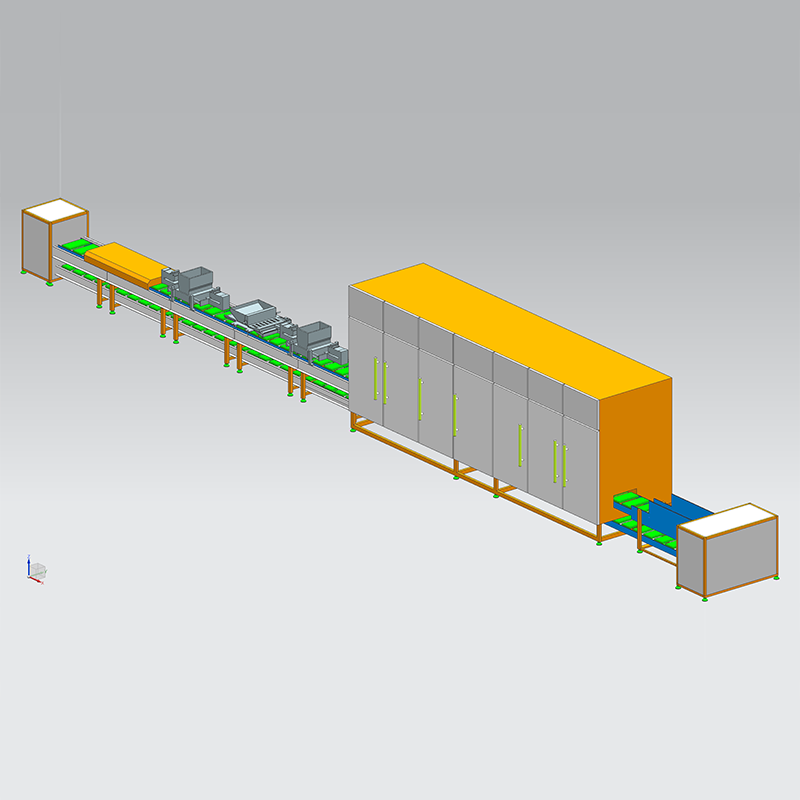
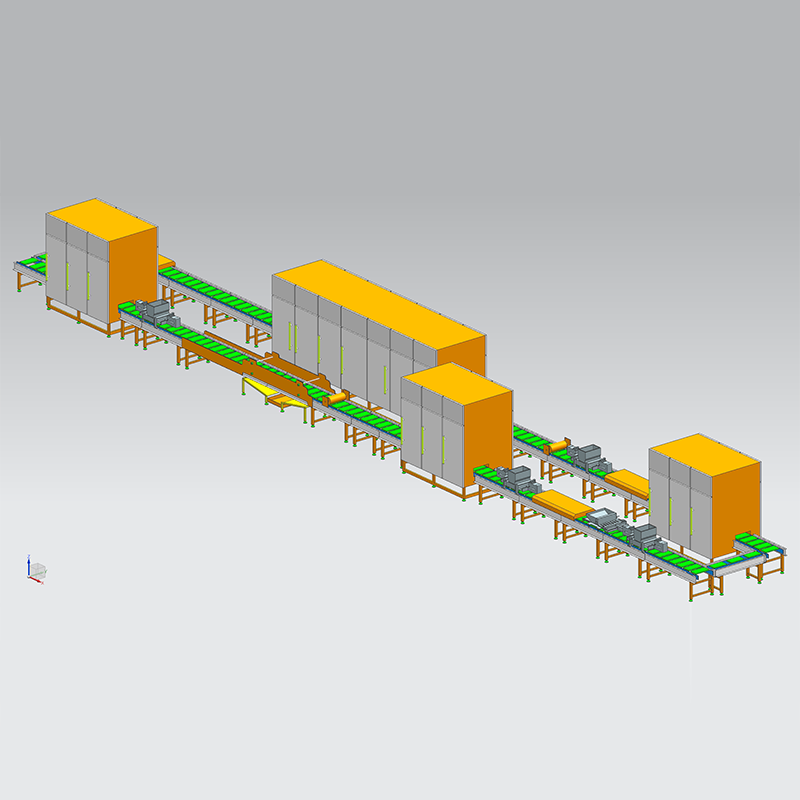
A standard Snicker production line follows a logical sequence of processing stages. Each stage contributes to the structural integrity and sensory quality of the final bar.
Stage 1 – Nougat Preparation and Forming
The base layer of a Snicker-style bar is nougat, produced by mixing aerated sugar syrup, glucose, egg white, and fat in a continuous or batch mixer. The nougat is then deposited onto a conveyor belt or into a slab former, where it is pressed to a uniform thickness typically between 10–20 mm. Consistent texture at this stage is critical for downstream cutting accuracy.
Stage 2 – Caramel Cooking and Layering
Caramel is prepared in a continuous caramel cooker that combines sugar, glucose syrup, cream or fat, and emulsifiers under controlled heat. The cooked caramel is deposited onto the nougat layer while still pliable. Caramel temperature at deposition is typically maintained between 60–75°C to ensure proper adhesion without deforming the nougat below.
Stage 3 – Peanut Application
Whole or half-roasted peanuts are distributed evenly over the caramel surface using a vibratory feeder or roller applicator. A gentle pressing roller ensures the peanuts are embedded into the caramel layer. Peanut coverage uniformity directly impacts visual consistency and weight accuracy in the finished bar.
Stage 4 – Slab Cooling and Cutting
The assembled slab — consisting of nougat, caramel, and peanuts — passes through a cooling tunnel where temperatures are reduced to below 18°C. This firms up the structure before cutting. A rotary or wire cutter then divides the slab into individual bar-sized pieces with minimal product loss.
Stage 5 – Chocolate Enrobing
Individual bars pass through a chocolate enrober where tempered chocolate (typically at 29–32°C for dark or milk variants) coats all surfaces uniformly. An air blower removes excess chocolate from the bottom, and a vibration table smooths the surface coating before the bars enter the final cooling tunnel.
Stage 6 – Final Cooling and Packaging
After enrobing, bars travel through a refrigerated tunnel at 8–14°C for several minutes to set the chocolate shell. Fully set bars are then transferred to automated flow-wrapping or pillow-packaging machines, completing the production cycle.
Key Equipment in a Snicker Chocolate Bar Processing Line
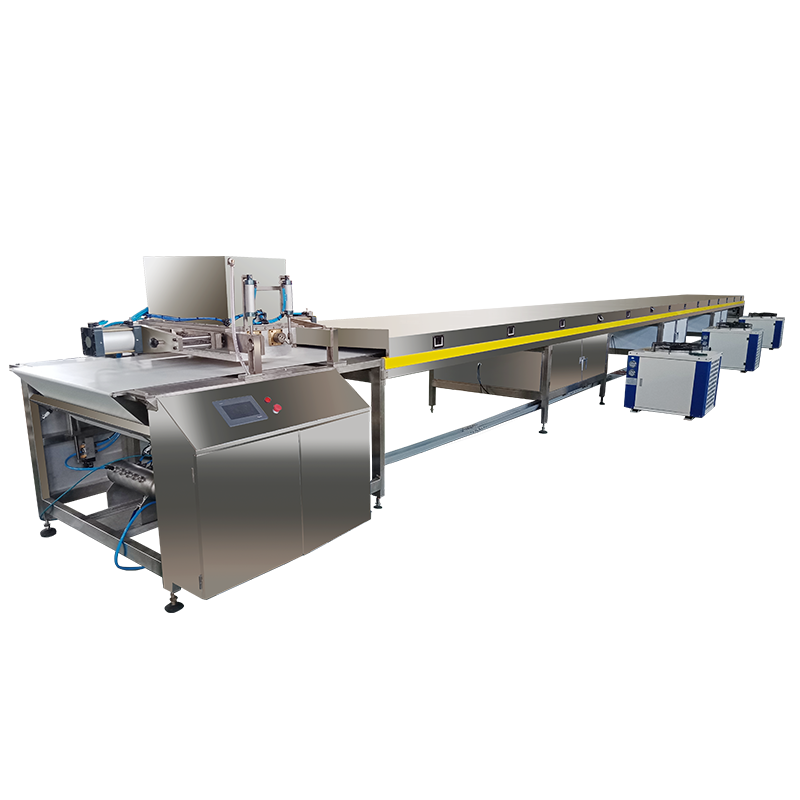
Each processing stage requires specialized equipment. Below is an overview of the primary machinery components and their functional roles:
| Equipment | Function | Key Parameter |
|---|---|---|
| Nougat Mixer & Former | Aerates and shapes the nougat base layer | Output: 100–500 kg/h |
| Caramel Cooker | Cooks and deposits caramel at controlled temperature | Temperature: 60–75°C |
| Peanut Feeder/Applicator | Distributes peanuts evenly over caramel | Coverage uniformity ±3% |
| Slab Cooling Tunnel | Firms the layered slab for cutting | Tunnel temp: 10–18°C |
| Rotary / Wire Cutter | Cuts slab into individual bars | Cutting speed: up to 120 cuts/min |
| Chocolate Enrober | Coats bars in tempered chocolate | Chocolate temp: 29–32°C |
| Final Cooling Tunnel | Sets the chocolate shell | Tunnel temp: 8–14°C |
| Flow Wrapper / Packaging Machine | Individually wraps finished bars | Speed: up to 600 bars/min |
Automation Levels and Production Capacity
Modern Snicker chocolate bar processing lines are available in three general automation tiers, each suited to different production scales and investment levels:
- Semi-automatic lines: Output of 150–250 kg/h; require manual feeding and monitoring at several stations; lower initial investment.
- Fully automatic lines: Output of 300–600 kg/h; PLC-controlled with minimal operator intervention; suitable for large-scale commercial production.
- Flexible multi-product lines: Adjustable molds, depositors, and cutting widths allow production of various bar formats (e.g., mini bars, king size) on the same line with quick changeover — typically under 30 minutes per format switch.
For a mid-scale manufacturer targeting 500,000–1,000,000 bars per day, a fully automated line running at 400 kg/h with an average bar weight of 50g would produce approximately 8,000 bars per hour or 192,000 bars per 24-hour shift.
Critical Quality Control Points on the Line
Maintaining consistent bar quality requires active control at several checkpoints throughout the Snicker production line:
- Nougat texture and density monitoring via inline viscometers or manual sampling every 30 minutes.
- Caramel moisture content checked after cooking — target moisture: 8–12% — to ensure the correct chewy texture.
- Bar weight verification using checkweigher systems immediately after cutting; typical tolerance is ±1.5g per bar.
- Chocolate coating thickness measured via X-ray or weight comparison before and after enrobing.
- Visual inspection stations (manual or camera-based) before packaging to detect bars with missing coating, peanut gaps, or dimensional inconsistencies.
Hygiene and Food Safety Design Considerations
Food-grade design is non-negotiable in a chocolate bar processing line. Key design principles include:
- Stainless steel 304 or 316 construction for all product-contact surfaces.
- CIP (Clean-in-Place) compatibility for depositors, cooking vessels, and enrobing pans to reduce manual cleaning time and cross-contamination risk.
- Enclosed conveyors in cooling tunnels to prevent airborne contamination during temperature transitions.
- Allergen management zones: peanut application areas should be physically separated or sequenced from allergen-free production runs.
- HACCP-compliant documentation integrated with PLC data logging for full traceability.
Common Operational Challenges and Solutions
Even well-configured lines encounter recurring issues. Below are the most common challenges and practical solutions:
| Challenge | Cause | Solution |
|---|---|---|
| Caramel sticking to cutters | Caramel too warm at cutting stage | Lower slab cooling tunnel temperature by 2–3°C |
| Uneven chocolate coating | Chocolate out of temper range | Recalibrate tempering unit; check for fat bloom triggers |
| Bar weight variation >±3g | Nougat or caramel layer thickness inconsistency | Inspect depositor nozzles; recalibrate former rollers |
| Peanut voids in bars | Feeder vibration too high or low | Adjust vibratory feeder frequency; clean hopper sensors |
| Packaging misalignment | Bar length variation after cutting | Synchronize cutter speed with conveyor belt speed |
Energy Efficiency in Snicker Bar Manufacturing
Cooling tunnels and cooking vessels are the highest energy consumers in a Snicker production line, together accounting for 55–70% of total line energy consumption. Practical measures to reduce energy costs include:
- Using heat recovery systems on cooking vessels to preheat incoming ingredients.
- Installing variable frequency drives (VFDs) on conveyor motors to reduce power draw during low-throughput periods.
- Scheduling deep-clean and maintenance cycles during off-peak energy hours.
- Optimizing tunnel length and fan speed based on real production rate rather than maximum design capacity.
A well-optimized fully automated line can produce one kilogram of finished bar using approximately 0.3–0.6 kWh, depending on climate conditions and plant layout.
FAQ
Q1: What is the typical footprint of a complete Snicker production line?
A full line including nougat forming, caramel, peanut application, enrobing, and packaging typically requires 40–80 meters in length and 4–8 meters in width, depending on automation level and cooling tunnel design.
Q2: Can the same line produce both regular and mini Snicker-style bars?
Yes. With adjustable depositors, modular molds, and reconfigurable cutters, most modern lines can switch between formats. Changeover time is typically 20–45 minutes.
Q3: What type of chocolate is used in a Snicker bar processing line?
Milk chocolate is most commonly used, with a cocoa content of 25–35%. The enrober handles both pre-tempered compound chocolate and real chocolate depending on product specification.
Q4: How many operators are needed for a fully automated line?
A fully automated line at 400 kg/h typically requires 3–6 operators per shift, covering quality checks, packaging replenishment, and minor adjustments.
Q5: What is the shelf life of bars produced on this type of line?
With proper chocolate enrobing and flow-wrap packaging, the shelf life of finished bars is generally 9–12 months at ambient temperatures below 20°C.
Q6: Is nougat always required in a Snicker-style bar line?
Nougat is the standard base, but the line can be adapted to use cookie, wafer, or cereal base layers instead, making it a versatile platform for multiple bar formats.