

 English
  Français
  عربى
عربى How does a chocolate tempering machine work?
Content
- 1 How a Chocolate Tempering Machine Works: The Core Principle
- 2 The Three-Stage Temperature Control Process
- 3 Key Mechanical Components Inside a Tempering Machine
- 4 Continuous vs. Batch Tempering Machines
- 5 The Role of Cocoa Butter Polymorphism
- 6 Tempering Degree and Quality Verification
- 7 Seeding Method vs. Traditional Tabling
- 8 Practical Factors That Affect Machine Performance
- 9 Frequently Asked Questions
- 9.0.1 Q1: Can a chocolate tempering machine handle dark, milk, and white chocolate?
- 9.0.2 Q2: How long does it take to temper a batch of chocolate in a machine?
- 9.0.3 Q3: What causes fat bloom even after machine tempering?
- 9.0.4 Q4: What is the minimum production volume where a tempering machine becomes worthwhile?
- 9.0.5 Q5: Do tempering machines work with compound chocolate (cocoa butter substitutes)?
- 9.0.6 Q6: How often does a tempering machine need maintenance?
How a Chocolate Tempering Machine Works: The Core Principle
A chocolate tempering machine works by precisely controlling the temperature of melted chocolate through a series of heating and cooling stages to encourage the formation of stable cocoa butter crystals (specifically Form V beta crystals). The result is chocolate with a glossy surface, satisfying snap, smooth texture, and longer shelf life. Without proper tempering, chocolate sets with a dull, soft, or streaky finish caused by unstable crystal structures.
The machine automates what chocolatiers once did by hand on marble slabs, eliminating human error and dramatically improving consistency at both small-batch and industrial scales.
The Three-Stage Temperature Control Process
Every tempering machine guides chocolate through three critical thermal phases. The exact temperatures vary slightly depending on chocolate type (dark, milk, or white), but the principle remains the same.
| Stage | Dark Chocolate | Milk Chocolate | White Chocolate | Purpose |
|---|---|---|---|---|
| Melt / Heat | 50–55°C | 45–50°C | 40–45°C | Destroy all existing crystal structures |
| Cooling | 27–28°C | 26–27°C | 25–26°C | Form stable Form V crystals |
| Working Temp | 31–32°C | 29–30°C | 27–28°C | Melt unstable crystals, keep only Form V |
At the working temperature, unstable crystal forms (I–IV) melt away while the desirable Form V crystals remain intact. The chocolate is now "in temper" and ready for molding, enrobing, or dipping.
Key Mechanical Components Inside a Tempering Machine
Understanding the internal structure reveals why these machines achieve results that manual tempering cannot reliably replicate at scale.
Heated Tank or Bowl
The chocolate is loaded into an insulated stainless-steel tank fitted with electric heating elements or a water-jacketed system. Temperature sensors (typically PT100 RTD probes with accuracy of ±0.1°C) continuously monitor the melt.
Auger Screw or Agitation Mechanism
A rotating auger screw moves chocolate through a cylindrical tempering column. This constant mechanical agitation serves two purposes: it promotes uniform heat distribution and physically assists crystal nucleation by creating shear forces in the liquid chocolate.
Cooling Column or Water Jacket
As chocolate travels down the tempering column, a surrounding water jacket circulates chilled water (typically at 15–18°C) to drop the chocolate temperature in a controlled, gradual manner. Precise water flow rate and temperature are regulated automatically.
Reheating Zone
After cooling, the chocolate passes through a gentle reheating zone that raises it back to the working temperature. This final step melts away any unstable crystals that formed during the cooling stage.
PLC Control System
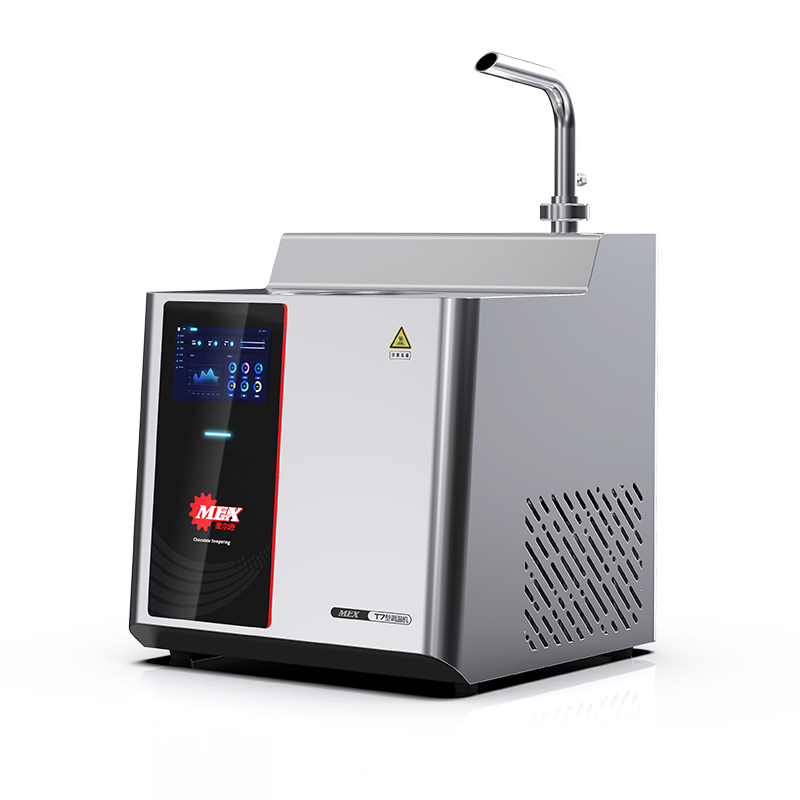
Modern machines use a Programmable Logic Controller (PLC) with a touchscreen interface. Operators can store multiple product profiles, set alarms for out-of-tolerance conditions, and log temperature data for quality audits. Some systems offer automatic tempering degree detection to verify that chocolate is properly crystallized before use.
Continuous vs. Batch Tempering Machines
There are two fundamental machine architectures, each suited to different production environments.
Continuous Tempering Machines
Chocolate flows through the machine in a constant stream, is tempered, and exits ready for immediate use. These are standard in industrial chocolate production lines handling hundreds to thousands of kilograms per hour. They maintain stable temper indefinitely as long as chocolate is fed in and consumed.
Batch Tempering Machines
A fixed quantity of chocolate is loaded, tempered, and then used entirely before the next batch begins. These are common in artisan chocolatiers, pastry kitchens, and small confectionery workshops typically working with 3 kg to 50 kg capacities. They offer flexibility for frequent flavor or type changes.
- Continuous machines: High throughput, minimal downtime, ideal for enrobing lines and molding lines
- Batch machines: Lower investment, easy cleaning, better for varied small-scale production
- Tabletop models: Entry-level units for workshops or R&D, capacities as low as 1–3 kg
The Role of Cocoa Butter Polymorphism
Cocoa butter can solidify into six different crystal forms (I through VI), each with different melting points and physical properties. Only Form V produces the characteristics consumers associate with premium chocolate:
- Melting point of approximately 33–34°C — just below body temperature, giving that characteristic melt-in-the-mouth sensation
- A sharp, audible snap when broken
- A smooth, glossy surface with no bloom
- Stable shelf life of up to 12–18 months without fat bloom
Form VI can also appear but only develops after very long storage periods and results in a dry, crumbly texture. The tempering machine's job is to produce Form V reliably — every batch, every time.
Tempering Degree and Quality Verification
A properly tempered chocolate contains approximately 1–3% by weight of Form V seed crystals dispersed through the liquid mass. Too few crystals result in under-tempered chocolate (soft, no snap, bloom-prone). Too many result in over-tempered chocolate (thick, pasty, sets too fast, poor surface finish).
Quality is verified using a tempering meter (temper tester), which measures the crystallization curve of a small sample. A correct curve shows a stable plateau during solidification, indicating the right crystal density. High-end tempering machines integrate this measurement directly into the control loop for fully automatic adjustment.
Seeding Method vs. Traditional Tabling
Most modern tempering machines use the seeding method rather than tabling (spreading chocolate on a cold marble surface). Seeding introduces pre-crystallized chocolate or cocoa butter in powder or micro-bead form directly into the melted mass.
- Chocolate is fully melted at 50–55°C to destroy all crystals
- Temperature is lowered to approximately 34°C
- Seed material (typically 1–2% of total weight) is added and mixed thoroughly
- The seed crystals propagate through the mass, converting liquid cocoa butter into Form V
- Working temperature is maintained until the chocolate is used
This method is faster, more consistent, and far easier to automate than tabling, making it the industry standard for machine-based tempering.
Practical Factors That Affect Machine Performance
Even with a high-quality machine, several operational variables influence tempering outcomes:
- Chocolate fat content: Higher cocoa butter content (above 36%) requires more precise cooling curves
- Ambient temperature and humidity: Workshops above 25°C or with humidity above 60% can destabilize temper; climate control is recommended
- Throughput rate: Running a continuous machine below its rated capacity can cause the chocolate to over-crystallize in the column
- Water quality: Hard water in the cooling circuit causes scale buildup and reduces heat transfer efficiency over time; regular descaling is essential
- Chocolate age: Old or previously mishandled chocolate with pre-existing Form VI crystals is harder to re-temper correctly
Frequently Asked Questions
Q1: Can a chocolate tempering machine handle dark, milk, and white chocolate?
Yes. Most machines allow operators to set different temperature profiles for each chocolate type. Dark chocolate requires the highest temperatures, while white chocolate needs the lowest. Switching between types requires thorough cleaning to avoid cross-contamination of flavors or allergens.
Q2: How long does it take to temper a batch of chocolate in a machine?
In a continuous machine, chocolate reaches working temperature within 10–20 minutes of startup. Batch machines typically require 20–45 minutes depending on the volume and starting temperature of the chocolate.
Q3: What causes fat bloom even after machine tempering?
Fat bloom after machine tempering is usually caused by temperature shock during cooling or storage (e.g., refrigerating warm chocolate), using chocolate with incompatible fats (such as lauric CBEs), or over-tempered chocolate that contracts unevenly during setting.
Q4: What is the minimum production volume where a tempering machine becomes worthwhile?
Even small artisan operations producing as little as 5–10 kg per day benefit from a tabletop tempering machine, as manual tempering is time-consuming and inconsistent. For production above 50 kg/day, a continuous machine typically offers a better cost-per-kg outcome.
Q5: Do tempering machines work with compound chocolate (cocoa butter substitutes)?
Compound chocolate containing lauric fats (palm kernel oil, coconut oil) does not require tempering because these fats have simpler crystallization behavior. Using a tempering machine on compound chocolate is unnecessary and can actually cause setting problems.
Q6: How often does a tempering machine need maintenance?
Daily cleaning of all chocolate-contact surfaces is required. The cooling water circuit should be descaled every 1–3 months depending on water hardness. Temperature sensors and seals should be inspected every 6 months, with full professional servicing recommended annually.