

 English
  Français
  عربى
عربى How Advanced Depositing and Moulding Lines Scale Confectionery Manufacturing
Content
- 1 Industrial Confectionery Shaping Systems
- 2 Mechanics of the Q11 Automatic Chocolate Moulding Line
- 3 Technical Specifications of Industrial Moulding Configurations
- 4 The Physics of Chocolate Chips Production
- 5 Forming and Calendering on Chocolate Beans Production Lines
- 6 Thermodynamic Cooling and Crystal Stabilization
- 7 Confectionery Production Frequently Asked Questions
- 7.0.1 Q1: Why do polycarbonate moulds require precise pre-heating before chocolate depositing?
- 7.0.2 Q2: How does a chocolate chips line adjust the physical size of the drops?
- 7.0.3 Q3: Can a standard automatic moulding line run chocolate formulations with nut inclusions?
- 7.0.4 Q4: What causes chocolate beans to break or crack during the roller calendering stage?
- 7.0.5 Q5: Why is dehumidification critical within the air conditioning loops of cooling tunnels?
Industrial Confectionery Shaping Systems
High-volume confectionery production demands absolute precision, thermal control, and mechanical reliability. At the center of modern industrial chocolate processing are automated systems engineered to transform liquid chocolate mass into structured, tempered, and perfectly portioned final products. Whether processing solid blocks, intricate filled pralines, mini drops, or sugar-shelled lentils, manufacturing facilities must deploy specialized forming configurations to achieve consistency across millions of units per day.
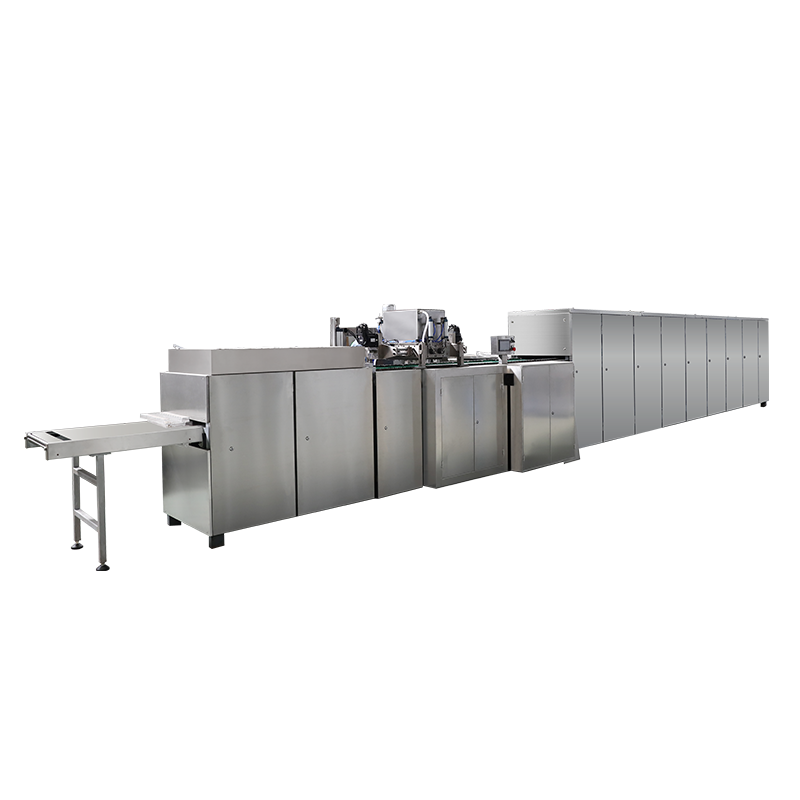
The transition from manual or semi-automated batch production to fully continuous operations involves a deep understanding of fluid dynamics, thermodynamic cooling, and mechanical synchronization. Liquid chocolate behaves as a non-Newtonian fluid, displaying thixotropic properties that require constant agitation, exact temperature ranges, and carefully calculated shear stresses during the depositing process. Minor variations in mass temperature or mechanical pressure can lead to structural defects, poor fat bloom stability, or inconsistent product weights. To mitigate these risks, modern confectionery facilities implement fully integrated systems such as the q11 automatic chocolate moulding line to stabilize variables across the production lifecycle.
Mechanics of the Q11 Automatic Chocolate Moulding Line
The processing architecture of an automated chocolate molding machine revolves around a continuous loop where rigid polycarbonate moulds undergo a sequence of precise thermal and mechanical treatments. Polycarbonate is selected as the primary material for modern confectionery moulds due to its high impact resistance, dimensional stability under temperature fluctuations, and excellent smooth surface finish, which imparts a high-gloss sheen to the finished chocolate bar.
The process sequence inside a multi-functional chocolate bar making machine can be divided into several critical stages:
- Mould Pre-heating: Before any liquid mass touches the polycarbonate surface, the empty moulds pass through an infrared or convective heating tunnel. Raising the mould temperature to within 1 to 2 degrees of the tempered chocolate mass (typically 29 to 31 degrees Celsius) prevents premature thermal shock, ensuring optimal lipid crystallization at the interface.
- Volumetric Depositing: The pre-heated moulds advance beneath a servo-driven chocolate depositor machine. The depositor uses precision pistons to draw a calibrated volume of chocolate from a jacketed, heated hopper and displace it directly into the mould cavities.
- Mechanical Demolding: After solidification in the cooling tunnel, the moulds are inverted, and a mechanical tapping or pneumatic flexing mechanism releases the solid bars onto a sanitary conveyor belt for packaging.
Multi-Shot Chocolate Depositing Technologies
Advanced configurations within a chocolate forming line utilize multi-shot chocolate depositing heads. This allows for the simultaneous or sequential injection of different masses into a single cavity. For instance, a dual-shot system can execute center-filled praline production by extruding an outer shell of milk chocolate while concurrently injecting a liquid praline, cream, or caramel core through a concentric inner nozzle nozzle mechanism. This precise coordination prevents the core material from breaking through the outer shell during the solidification phase.
Technical Specifications of Industrial Moulding Configurations
To maintain consistent product throughput and mechanical synchronization, industrial lines operate within rigid mechanical and thermodynamic operational parameters. The table below outlines the engineering benchmarks for solid and multi-shot chocolate molding machine processes operating at peak capacity.
| Process Variable | Solid Chocolate Bar Block | Center-Filled Praline | Two-Color Inclusion Item |
|---|---|---|---|
| Mould Pre-Heat Temp | 28 to 30 degrees Celsius | 29 to 31 degrees Celsius | 28 to 29 degrees Celsius |
| Piston Cycle Speed | 22 to 28 strokes per minute | 18 to 22 strokes per minute | 15 to 20 strokes per minute |
| Vibration Frequency | 45 to 50 Hertz | 35 to 40 Hertz | 40 to 45 Hertz |
| Cooling Tunnel Time | 18 to 24 minutes | 25 to 35 minutes | 20 to 26 minutes |
| Air Velocity | 4.5 to 6.0 meters per second | 3.5 to 4.5 meters per second | 4.0 to 5.0 meters per second |
The Physics of Chocolate Chips Production
Industrial baking and confectionery operations rely heavily on standardized drop-shaped components. When evaluating chocolate chips line setups, the core question is often: how are chocolate chips made at an immense scale without sacrificing shape uniformity? The answer lies in the mechanical action of an industrial chip drops depositor working in conjunction with a high-velocity cooling tunnel integration.
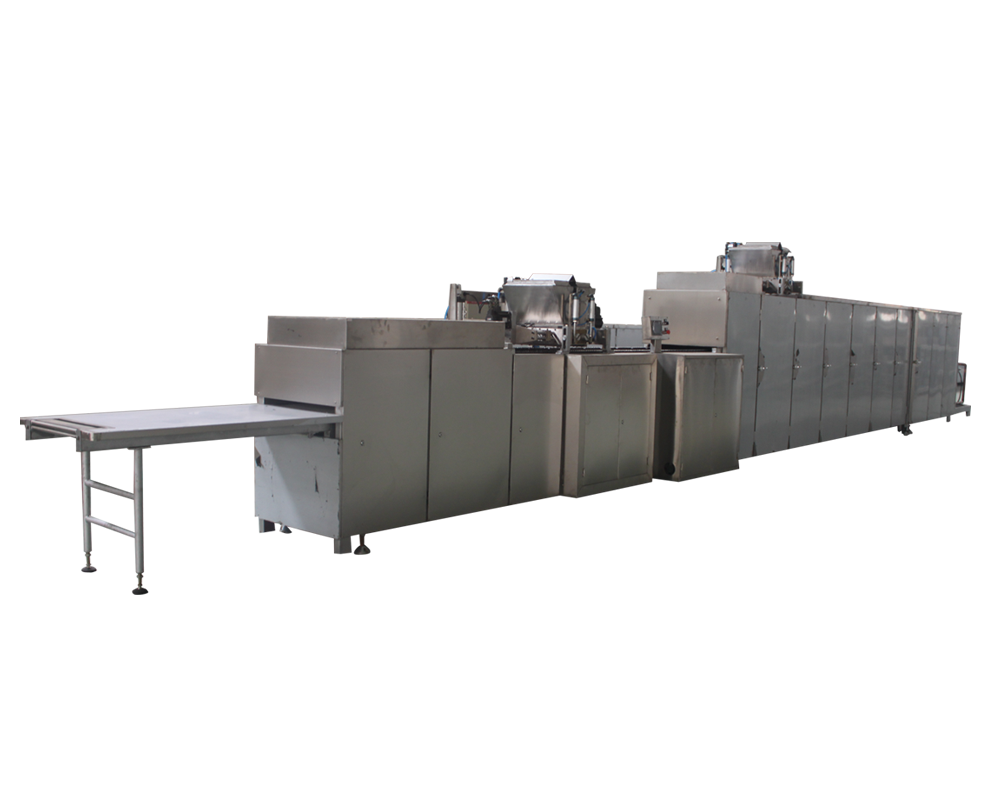
The manufacturing process bypasses polycarbonate moulds entirely, instead depositing the mass directly onto a food-grade polyurethane or stainless steel conveyor belt. The primary component driving this process is a rotary drop depositor or a manifold plate equipped with rapid-action needle valves. Liquid chocolate is forced through rows of precision orifices spanning the entire width of the belt.
How Are Chocolate Chips Made: Step-by-Step
- Mass Feed and Pressure Stabilization: Tempered chocolate mass is pumped into a jacketed distribution manifold. Internal pressure must remain completely uniform across the entire width of the manifold to ensure that the chips deposited on the outer edges have the exact same mass as those in the center.
- Drop Formation: As the deposition nozzle opens, a specific volume of chocolate flows onto the moving belt. The downward velocity of the chocolate mass and the horizontal velocity of the belt interact to form the base diameter of the chip.
- The Snapping Action: To create the characteristic peaked top of the chocolate button or chip, the nozzle assembly or needle valve cuts off the flow sharply while executing a slight upward vertical movement or utilizing a quick pulse of compressed air. This separates the tail of the fluid mass, allowing surface tension to pull the top into a point before hitting the cooling belt.
- Rapid Convective Cooling: The belt immediately carries the rows of formed chips into a multi-zone cooling tunnel. Because the surface-area-to-volume ratio of a chip is much larger than that of a standard chocolate bar, the cooling profile must be aggressively managed to lock in the crystal structure without causing thermal cracking or un-tempered bases.
Forming and Calendering on Chocolate Beans Production Lines
Chocolate lentils, beans, or spheres present a unique manufacturing challenge due to their three-dimensional curved surfaces. Unlike bars or chips, which have a flat underside from resting on a mould surface or conveyor belt, chocolate buttons and bean-shaped centers require complete structural isolation during formation. This is achieved via a specialized chocolate beans production line utilizing double-roller calendering technology.
The process depends on two parallel, counter-rotating steel rollers that are internally chilled to sub-zero temperatures (frequently between -15 and -25 degrees Celsius). The surfaces of these rollers are precision-machined with matching half-cavities. As liquid, un-tempered or partially tempered chocolate is fed into the nip point between the two rollers, the mass is instantly frozen upon contact with the cold steel surfaces.
The chilled rollers compress the chocolate into a continuous web or sheet consisting of solidified bean centers held together by a thin flash layer of chocolate. This cold, brittle web is discharged from the underside of the rollers onto a continuous cooling conveyor belt. The conveyor transports the web through a stabilization tunnel where the internal chocolate structure finishes hardening throughout its entire core volume.
Once fully solidified, the web passes into a mechanical tumbling drum. The rotating motion of the drum causes the brittle flash margins to crack off and separate from the hardened cores. The separated flakes are collected below a screen and routed back to a melting tank for full recycling, ensuring zero raw material waste. The smooth, rounded chocolate bean centers are then ready to be transferred to the sugar coating department, where multiple layers of syrup and wax polish are applied in panning drums to achieve the final crisp exterior shell.
Thermodynamic Cooling and Crystal Stabilization
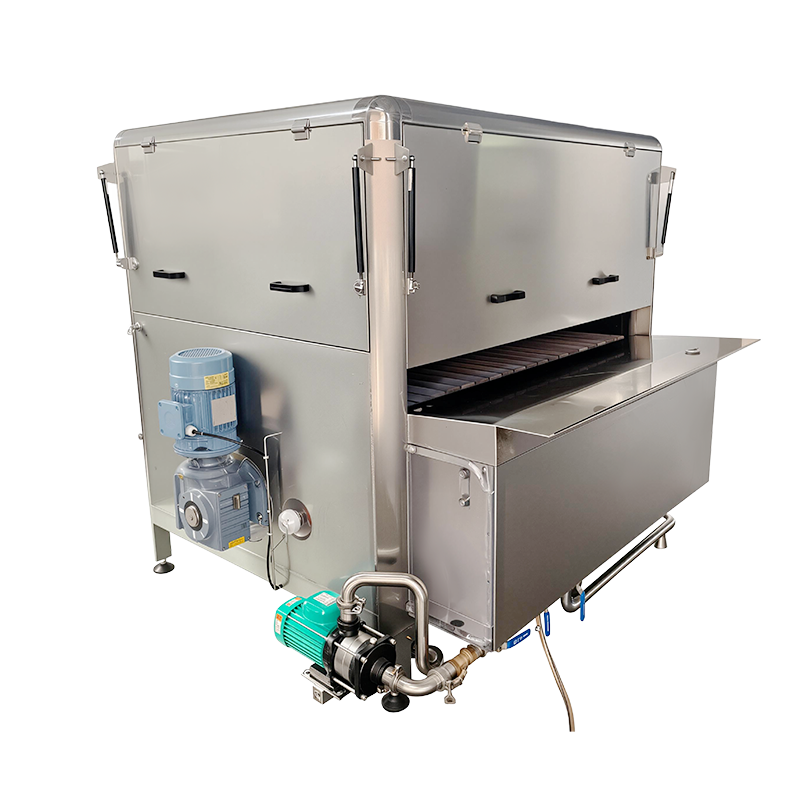
The performance of any depositor or molding machine is directly constrained by the capabilities of its downstream cooling tunnel integration. Chocolate solidification is not merely a process of temperature reduction; it is a complex crystallization process. Cocoa butter consists of multiple polymorphic glycerides that must be guided into stable Form V crystals to guarantee structural hardness, a clean snap, and long-term resistance to fat bloom.
Industrial cooling tunnels are engineered with distinct operational zones to optimize this crystalline transition:
- Zone 1: Radiation Pre-cooling: This initial zone gently reduces the temperature of the entering chocolate mass from roughly 30 degrees Celsius down to 24 degrees Celsius using radiant cooling plates or low-velocity air currents. This slow initial step prevents the shock formation of unstable Form IV crystals at the top surface of the chocolate product.
- Zone 2: Convective Solidification: This is the coldest area of the tunnel, utilizing high-velocity, counter-current air flow at temperatures ranging between 11 and 14 degrees Celsius. This stage rapidly extracts the latent heat of crystallization released by the stabilizing cocoa butter lipids.
- Zone 3: Re-heating and Conditioning: Before exiting into the open packaging room, the chocolate passes through a final chamber where the temperature is gradually raised back up to 16 to 18 degrees Celsius. This brings the product above the ambient dew point of the manufacturing floor, eliminating the risk of water condensation forming on the surface of the chocolate, which would otherwise dissolve surface sugars and cause permanent sugar bloom defects.
Confectionery Production Frequently Asked Questions
Q1: Why do polycarbonate moulds require precise pre-heating before chocolate depositing?
If chocolate is deposited into cold polycarbonate moulds, the liquid mass undergoes an immediate thermal shock. This rapid cooling causes unstable lipid crystals to form instantly at the surface, resulting in a dull exterior finish, structural brittleness, and a lack of clean demolding. Pre-heating to within 1 to 2 degrees of the tempered mass ensures that stable Form V crystals form evenly across the entire surface interface.
Q2: How does a chocolate chips line adjust the physical size of the drops?
The count-per-kilogram or physical size of chocolate chips is controlled by adjusting three distinct variables: the volumetric stroke displacement of the depositor piston, the linear velocity of the underlying conveyor belt, and the temperature-dependent viscosity of the tempered chocolate mass. Finer adjustments to the peak shape are handled by altering the vertical stroke timing of the nozzle separation mechanism.
Q3: Can a standard automatic moulding line run chocolate formulations with nut inclusions?
Yes, provided the depositor unit is equipped with specialized inclusion valves and a rotary steering mechanism. The inclusion pieces must be accurately diced and blended into a homogeneous mixture within a jacketed mixing hopper before entering the depositor manifold to prevent mechanical blockages within the piston chambers or nozzle plates.
Q4: What causes chocolate beans to break or crack during the roller calendering stage?
Cracking occurs if the chilled roller temperatures are set too low relative to the operational feed rate, causing the chocolate mass to become excessively brittle before the web structure is completely formed. Alternatively, it can be caused by improper alignment of the matching half-cavities on the two counter-rotating rollers, creating structural weaknesses along the central flash plane.
Q5: Why is dehumidification critical within the air conditioning loops of cooling tunnels?
Dehumidification systems keep the relative humidity inside the cooling tunnel below 45 percent. If warm, humid ambient factory air enters the cooling zones, moisture will condense on the cold product surfaces. This condensation dissolves the sucrose present within the chocolate formulation, which leaves behind a white, powdery crystalline residue known as sugar bloom once the moisture evaporates.